
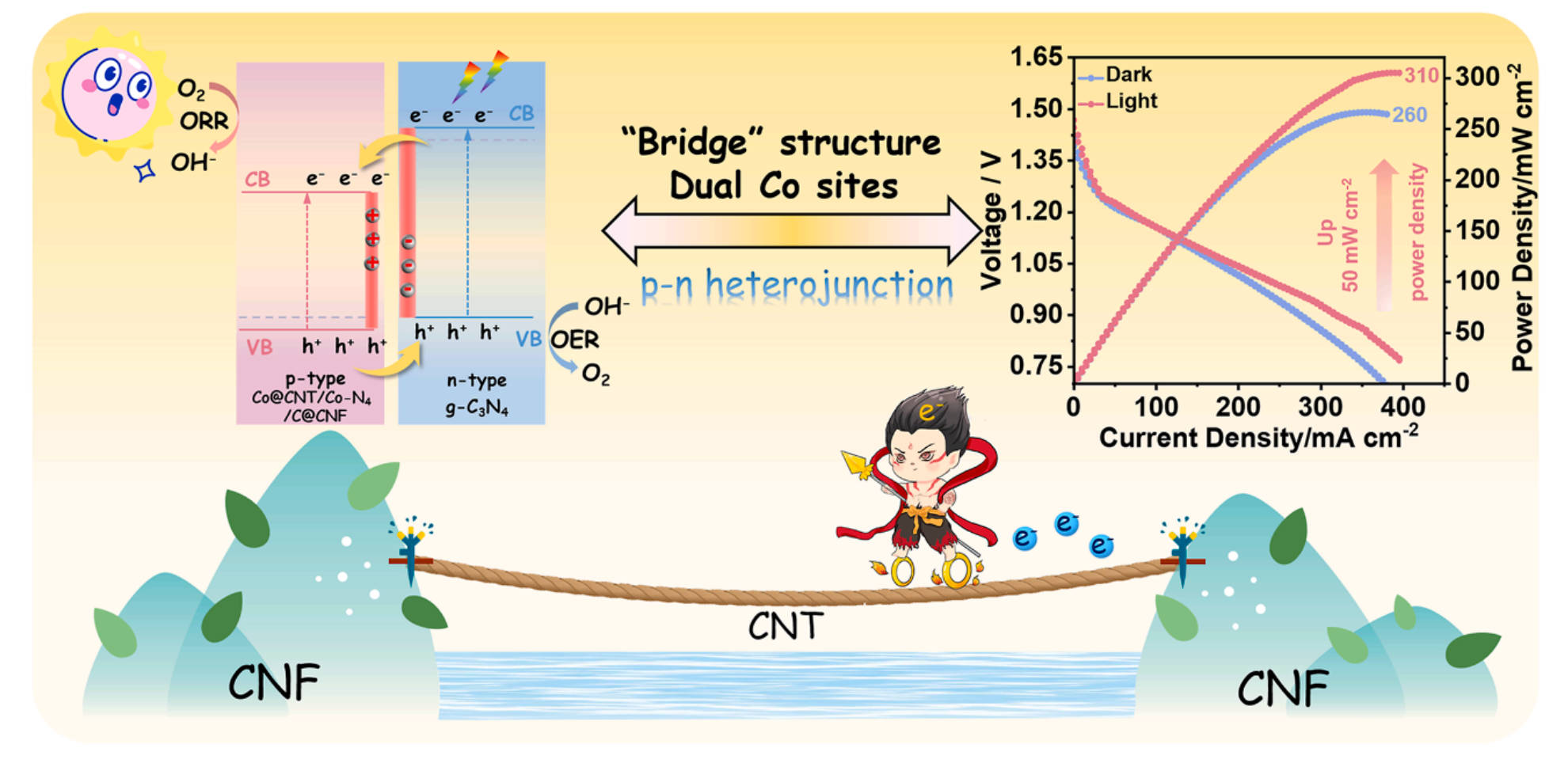
Light-activated p–n heterojunction with dual cobalt sites enhances zinc–air battery performance.
GA, UNITED STATES, February 3, 2026 /EINPresswire.com/ -- Rechargeable zinc–air batteries are widely regarded as promising next-generation energy storage systems, yet their practical performance is fundamentally limited by sluggish oxygen reduction and
evolution reactions at the air cathode. In this study, researchers report a photo-electroactive bifunctional catalyst that integrates a p–n heterojunction with dual cobalt active sites to simultaneously enhance catalytic kinetics and durability. By combining light-responsive carbon nitride with a conductive carbon nanofiber framework hosting both cobalt nanoparticles and single-atom cobalt sites, the system enables efficient charge separation and accelerated oxygen redox reactions under illumination. The result is a zinc–air battery that delivers substantially higher power output, improved energy efficiency, and exceptionally long cycling stability compared with conventional designs.Zinc–air batteries offer high theoretical energy density, intrinsic safety, and abundant raw materials, making them attractive for large-scale energy storage and flexible electronics. However, their real-world deployment remains constrained by slow oxygen electrochemistry at the air electrode, which leads to high overpotentials, limited power density, and rapid performance degradation. Conventional bifunctional catalysts often suffer from poor active-site accessibility, particle agglomeration during synthesis, and inefficient charge transport, especially under prolonged operation. Recent efforts to couple electrocatalysis with external stimuli such as light have shown promise, but integrating photoactivity with durable, high-performance air electrodes remains challenging. Based on these challenges, it is necessary to carry out in-depth research on photo-enhanced electrocatalysts for zinc–air batteries.
Researchers from Donghua University and collaborating institutions report a light-enhanced zinc–air battery enabled by a novel photo-electroactive air cathode, published (DOI: 10.1016/j.esci.2025.100450) in eScience on January 2026. The study introduces a p–n heterojunction catalyst that combines graphitic carbon nitride with a carbon nanofiber network hosting dual cobalt active sites. Under light irradiation, the catalyst significantly accelerates oxygen reduction and evolution reactions, leading to higher power density, improved energy efficiency, and unprecedented cycling stability in both liquid and flexible zinc–air battery configurations.
The core innovation lies in the rational integration of photoactivity and electrocatalysis within a single air-electrode architecture. The catalyst consists of graphitic carbon nitride nanosheets coupled to a self-supporting carbon nanofiber framework embedded with two complementary cobalt active sites: cobalt nanoparticles encapsulated in carbon nanotubes and atomically dispersed Co–N₄ moieties. This design forms a type-II p–n heterojunction that promotes directional charge transfer when exposed to light.
Upon illumination, photogenerated electrons migrate toward the conductive carbon framework to drive the oxygen reduction reaction, while holes facilitate the oxygen evolution reaction on adjacent sites. This spatial separation suppresses charge recombination and lowers reaction energy barriers. Electrochemical measurements reveal a remarkably small oxygen reaction overpotential gap of 0.684 V under light, outperforming many state-of-the-art bifunctional catalysts.
When assembled into practical zinc–air batteries, the photo-enhanced system achieves a peak power density of 310 mW cm⁻² and maintains stable charge–discharge operation for over 1,100 hours. Flexible battery prototypes further demonstrate strong mechanical robustness, retaining performance under repeated bending. Density functional theory calculations confirm that the heterojunction modulates the electronic structure of cobalt sites, optimizing oxygen intermediate adsorption and reaction kinetics.
“This work demonstrates how light can be actively harnessed to reconfigure catalytic reaction pathways rather than simply serving as an external energy input,” said one of the study's senior authors. “By engineering a p–n heterojunction with dual cobalt sites, we were able to achieve both high activity and long-term durability in zinc–air batteries. The synergy between photogenerated charge carriers and electrochemical reactions opens new possibilities for designing next-generation air electrodes that operate more efficiently and under milder conditions.”
The findings provide a versatile strategy for advancing zinc–air batteries toward real-world applications, including grid-scale energy storage, wearable electronics, and solar-assisted power systems. By leveraging light to enhance oxygen electrochemistry, the approach reduces energy losses and extends device lifetime without relying on precious metals. Beyond zinc–air batteries, the design principles demonstrated here could be applied to other metal–air batteries and photo-assisted electrochemical systems. More broadly, this work highlights a promising pathway for integrating solar energy directly into electrochemical energy storage, potentially bridging the gap between renewable energy harvesting and efficient energy utilization.
DOI
10.1016/j.esci.2025.100450
Original Source URL
https://doi.org/10.1016/j.esci.2025.100450
Funding information
This work is financially supported by the National Key Research and Development Program of China (2022YFE0138900), National Natural Science Foundation of China (21972017), the Fundamental Research Funds for the Central Universities (2232022D-18, CUSF-DH-T-2023061), Shanghai Sailing Program (22YF1400700) and the Chenguang Program of Shanghai Education Development Foundation and Shanghai Municipal Education Commission (22CGA37).
Lucy Wang
BioDesign Research

No comments:
Post a Comment